Documenting an orthopaedics admission
Operation notes from theatre, ward notes after arthroplasty and trauma, discharge summaries, GP letters and work certificates.
Day one after a total knee replacement
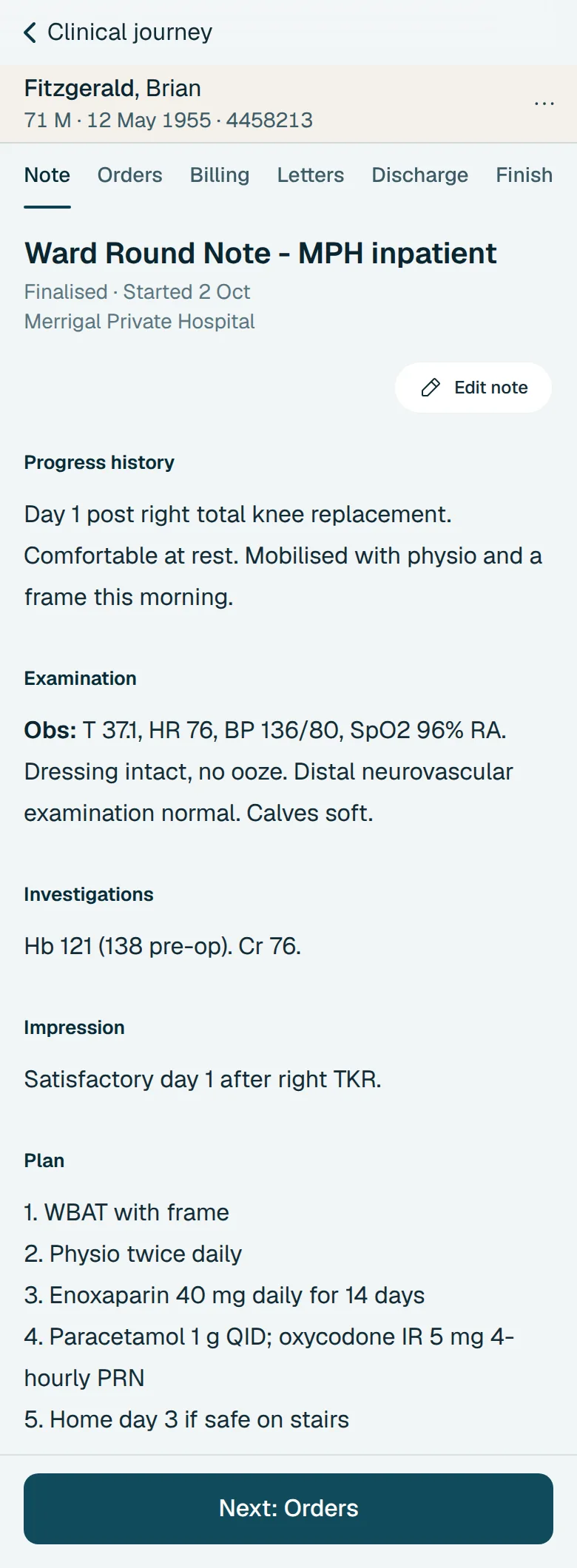
Day one right total knee replacement. Comfortable at rest. Mobilised with physio and a frame this morning.
Obs: thirty-seven one, heart rate seventy-six, BP one thirty-six on eighty, sats ninety-six on room air. Dressing intact, no ooze. Distal neurovascular exam normal, calves soft.
Hb 121 from 138 pre-op, Cr 76.
Satisfactory day one.
Weight bear as tolerated with the frame, physio twice a day. Enoxaparin 40 daily for fourteen days. Paracetamol 1 g QID, oxycodone IR 5 four-hourly PRN. Home day three if he's safe on the stairs.
Where each document comes from
The operation note is drafted from theatre, the progress notes from each ward review, and the discharge summary and GP letter at discharge.
- Operation note
- Dictated at the end of the case: approach, implants and sizes, cementing, tourniquet time, closure and the post-operative orders.
- Progress notes
- One per ward review.
- Discharge summary and GP letter
- The operation, Hb and wound course, weight-bearing status, VTE prophylaxis with its end date, analgesia with a stop plan, and the wound review.
- Work certificate
- For a trauma patient of working age: restrictions on lifting and weight bearing, and the review date.