aurii for private hospitals and groups
One agreement for the group, central invoicing on NET 30, and every clinician on the same patient record.
Evidence for the credentialing and IT security committee
The pack is the security architecture (residency, encryption, the audit chain, access, backup and incident response), the subprocessor list (every third party that touches patient data, with its region), the Australian Privacy Principles mapping, the clinical safety position (sign-off, clinical responsibility and the limits of drafting), the data processing agreement on request, and the audit trail walkthrough on a synthetic admission.
aurii carries the admission: the patient and episode record, pathology and imaging orders, handover and discharge, correspondence and delivery, the billing items for the practice to claim, and the audit chain. Native billing in the app is coming. Drafting the note from a recording is one part of the platform, and that is where aurii differs from an AI scribe.
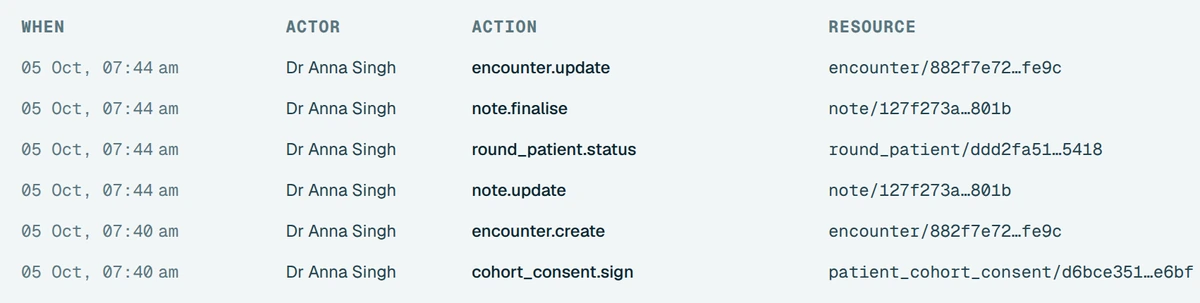
The audit log records which user account created, changed or signed each record, and when. Each entry is hash-chained to the one before it. Synthetic patient.
Governance questions
Every practice runs in its own logical tenant. A request is scoped to one tenant before it touches data.
Patient records and backups are held in Australian regions of Microsoft Azure.
Access uses multi-factor authentication on every account: passkeys (WebAuthn) or time-based one-time codes (TOTP). SSO and SAML federation are not offered.
An administrator deactivates a clinician. Access is revoked immediately and the audit history of what they signed is kept.
Named accounts at aurii and at Black Shard hold fleet-wide access to production through a support console. A practice cannot grant, extend or revoke that access. A change made from that console requires a password and second-factor sign-in within the previous five minutes, and is written to the practice's audit chain with the actor role recorded as superadmin. Console reads are not written to the chain.
aurii enforces no retention period of its own; the seven-year record-keeping obligation sits with the practice. A practice can have its records deleted on request.
Purge on request is scheduled with a seven-day grace window, recorded in the audit chain, and carried out by the platform operator.
Signed letters go to the GP over Medical Objects.
No. Your content is not used to train models.
Support is by email and scheduled calls on Australian business hours.
No separate SLA. Planned maintenance is notified where practical, and encrypted database backups are held for 35 days, under the availability terms.
Commercial terms
- Priced per active clinician.
- One invoice for the group, on NET 30 terms. Card details are handled by Stripe.
- Month to month, with no lock-in.
- The hospital can export its records at any time as one JSON file: an owner or administrator runs the export from the admin screen, covering patients, encounters, notes and letters, with the audit log alongside.
Hospitals and groups are quoted separately from the single-clinician plan.
Rollout path
-
Governance walkthrough
A 45-minute session with your IT and clinical governance leads, and procurement if they want it, working through tenancy, hosting, MFA, retention and the audit log.
-
Agreement and tenant
One agreement for the group and the data processing agreement, usually signed in about a week. The tenant is set up, the templates loaded and the administrators named.
-
First ward live
One ward live on real admissions. The specialists on that round use aurii for orders to ward nursing and providers, letters over Medical Objects, and the billing items each practice claims. Nothing is sent until a clinician signs it.
-
Group rollout
Then every site, on the same agreement and one invoice, with a review on the group's own numbers.
Arrange the walkthrough
Name two or three times that suit. Replies come within one Australian business day.