What aurii does across an admission

One patient record holds every note, letter, order and result in an admission. Each review drafts that day's note, and the discharge summary and GP letter are drafted at discharge from the admission's notes, for the treating clinician to sign.

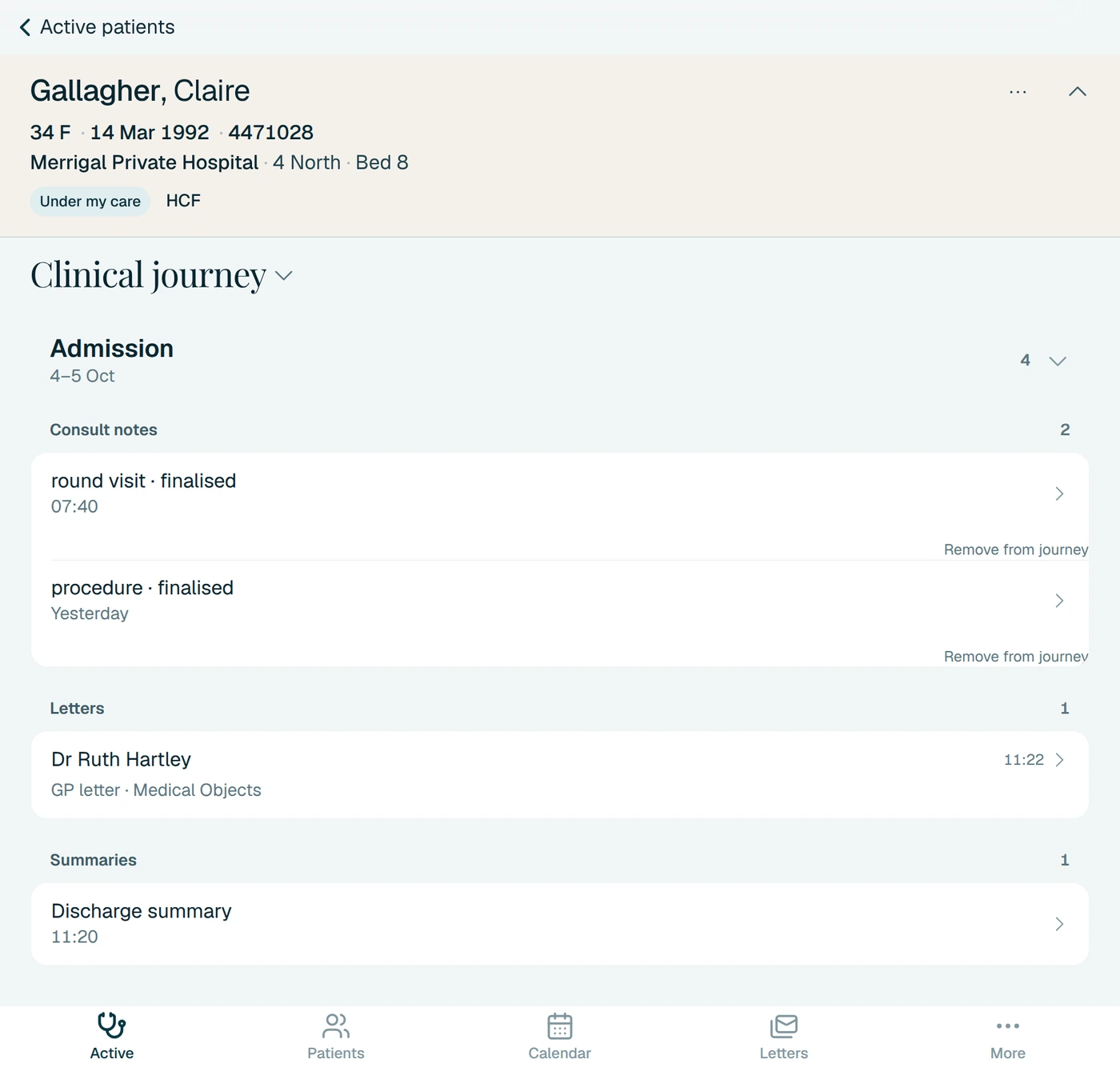
The clinical journey in aurii for Gallagher, Claire, Merrigal Private Hospital, 4 North, Bed 8, for the admission of 4 to 5 October 2026: two finalised consult notes (the procedure on 4 October and the round visit on 5 October), the GP letter to Dr Ruth Hartley sent over Medical Objects, and the discharge summary.
One admission on the patient record, 4 to 5 October. Synthetic patient. Full size

One admission on film

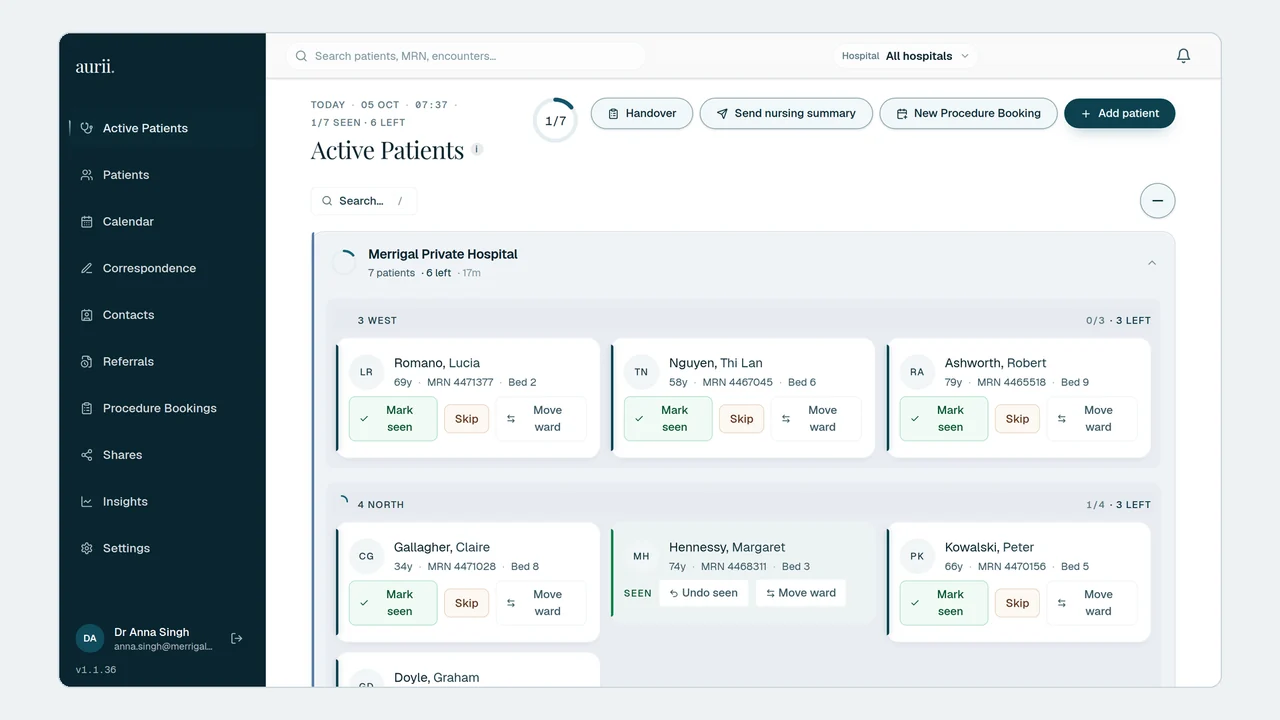
The same admission in the app, from the ward board to the audit log.

Captioned, no sound. Synthetic patients.

The shared record

Surgeon, physician and registrar work from the same patient record, on the ward, in theatre and in rooms.

Capture

  • Sign-in and accessSign-in uses a passkey (WebAuthn) or a time-based one-time code. Access is scoped to the practice, and each membership carries one of four roles: owner, administrator, doctor and read only.
  • Patient master and OCROne record per patient, kept reconciled. Photograph a referral or an admission form and aurii reads the details into the chart.
  • Consult captureThe bedside conversation is recorded hands-free, or dictated, and drafted into your note and letter templates.

Charts and rounds

  • Chart and timelineEvery note, result, letter and decision sits on one searchable patient timeline.
  • Shared timelinesSurgeon, physician and registrar work from the same record, with access scoped to the practice and logged.
  • Ward roundsYour list, ordered for the round. Open each patient, speak and sign in turn.
  • Order pathology and imagingPathology, imaging and procedure bookings are ordered from the patient record on the round. An order goes by email to the provider, to ward nursing or to the patient, and a procedure booking goes to the hospital booking officer. Each order shows Draft, Ready to send, Sent or Received on the record.

Correspondence

  • LettersGP discharge summaries, referrals, specialist-to-specialist letters and family updates, drafted from the consult.
  • Inbox and tasksOne queue for notes to sign, letters to approve and results to action.
  • DeliverySigned letters go out over Medical Objects as HL7 v2, and the delivery acknowledgement comes back to the letter.

Discharge and billing

  • Discharge summaryDrafted from the admission’s notes, letters and results.
  • Billing itemsThe billing items for each episode are drafted for the clinician to confirm and the practice to claim. Native billing in the app is coming.
  • Audit trailThe draft, the doctor’s edit and the signed version stay on the record.

Note quality

  • Note and letter templatesYour note and letter formats are held as templates. Every draft is written into them, and adjusting a template changes later drafts.
  • Corrections before signingYou edit the draft in the note before you sign. Every version is kept in the audit trail.
  • Recording with no signalaurii records on the phone with no network and uploads when the phone reconnects.

The surgeon's edit before signing

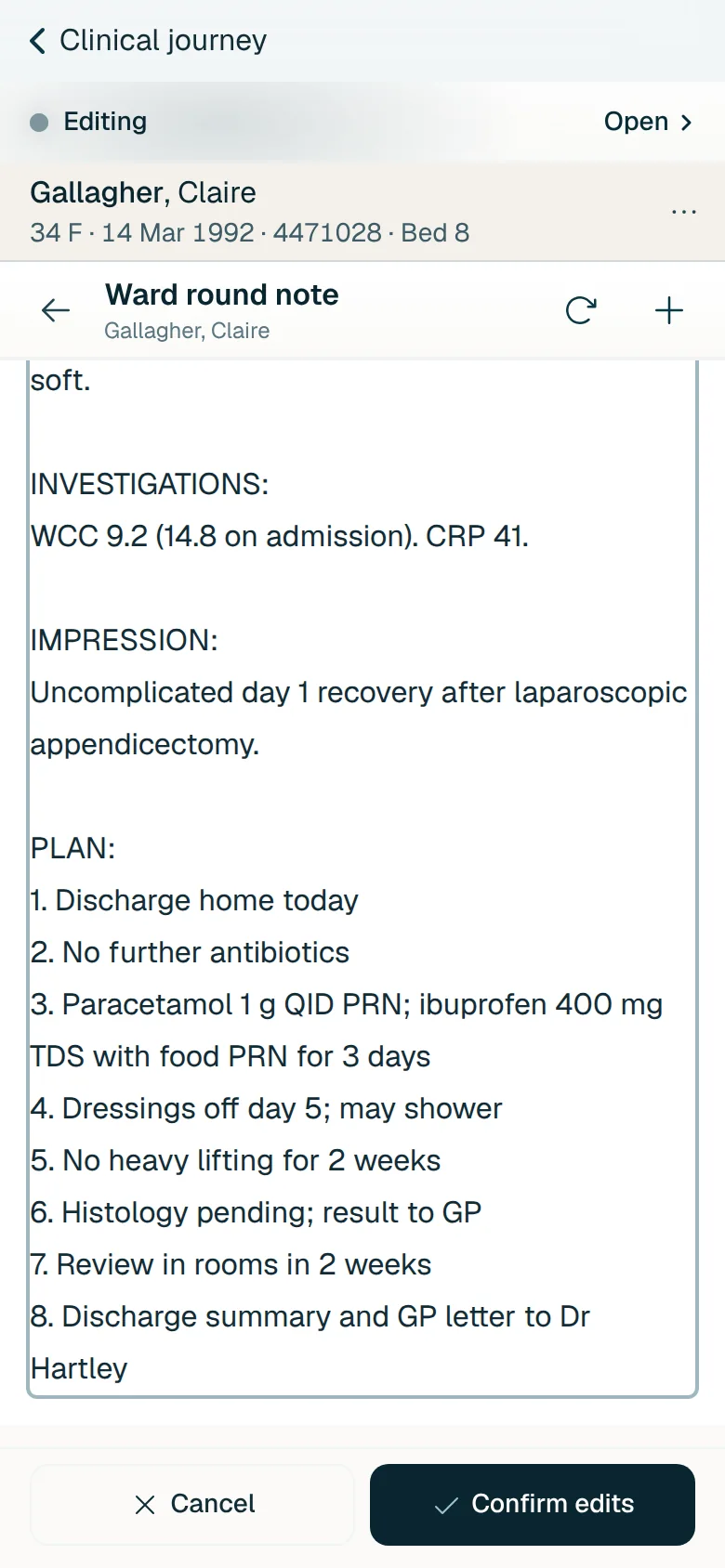
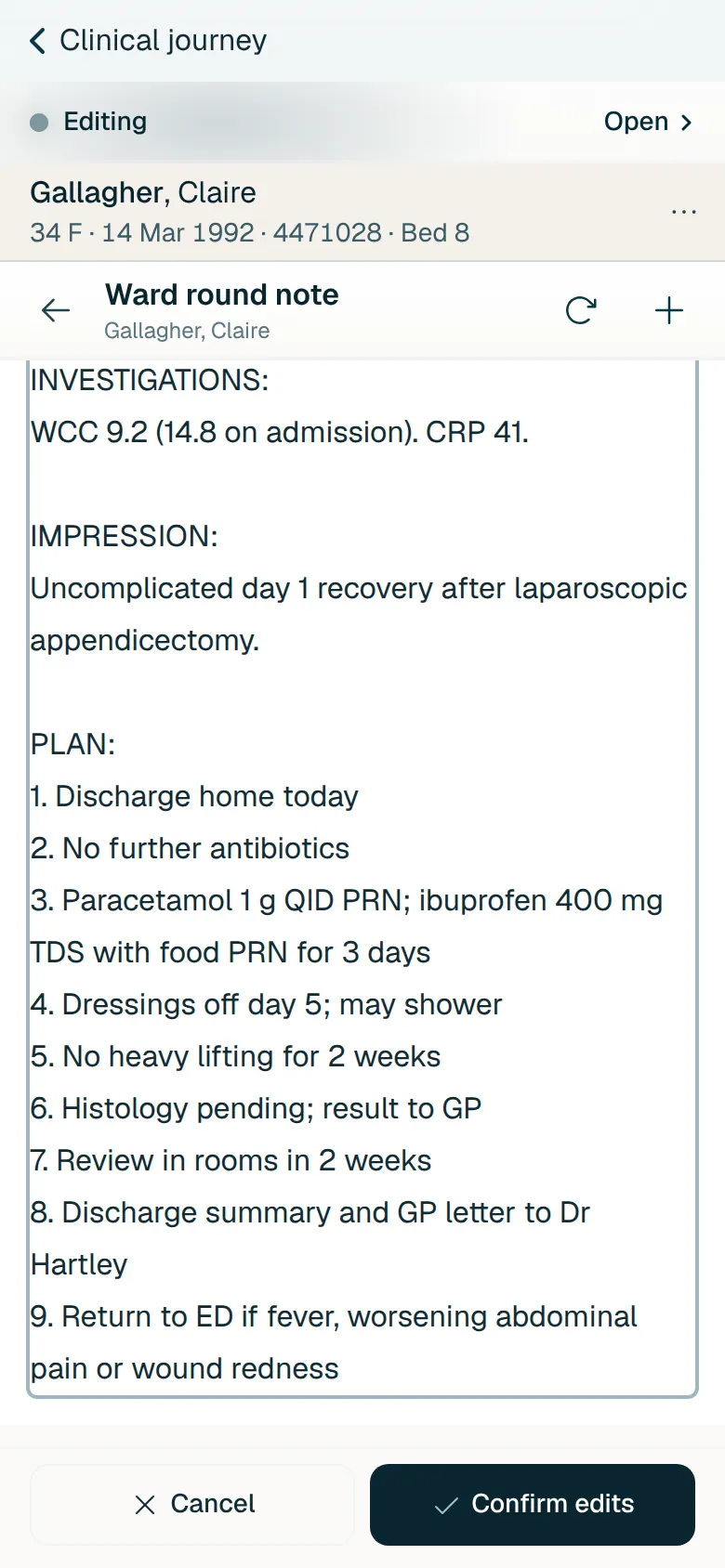
The aurii note editor on a phone for Gallagher, Claire, showing the impression and an eight-line plan before the edit. The same editor after the edit, with plan line 9 added: return to ED if fever, worsening abdominal pain or wound redness.
The surgeon adds plan line 9 before signing. Synthetic patient.

What to check before implementing aurii

  1. What it drafts

    Each review drafts that day's note; the discharge summary and GP letter are drafted at discharge from the admission's notes. Every draft uses your letterhead and section order, set once in your templates.

  2. Signing and clinical safety

    A draft that has not been signed cannot be dispatched, and the same gate applies to every delivery channel. Nothing leaves aurii until a clinician signs it.

  3. Who carries the clinical content

    The treating clinician remains responsible for the clinical content.

  4. Where the record is hosted

    Sydney is the primary region, with geo-redundant copies held in Australia. Patient records and backups are held in Australian regions of Microsoft Azure.

  5. How correspondence reaches the referrer

    Practices running Best Practice, MedicalDirector, Genie, Zedmed or Gentu are reachable on the Medical Objects network. Signed letters go to the GP over Medical Objects.

  6. Where claiming stands

    aurii drafts the billing items from each review for your practice to confirm and claim. Native billing in the app is coming.

  7. What the audit trail records

    Each entry is chained to the one before it, so an altered or removed row breaks the chain, and the verification runs from the product. Every action a practice user takes is written to a hash-chained audit log.

  8. Deletion and data retention

    A practice can have its records deleted on request.

  9. How a clinician gets it

    The aurii app is on the Australian App Store for iPhone and iPad and on Google Play for Android, and aurii runs at app.aurii.com.au in a browser.

  10. What it costs

    A$199 + GST per clinician per month, or paid yearly A$1,908 + GST per clinician per year (A$2,098.80 including GST), on one plan with no lock-in term. Hospitals and groups are quoted separately.